

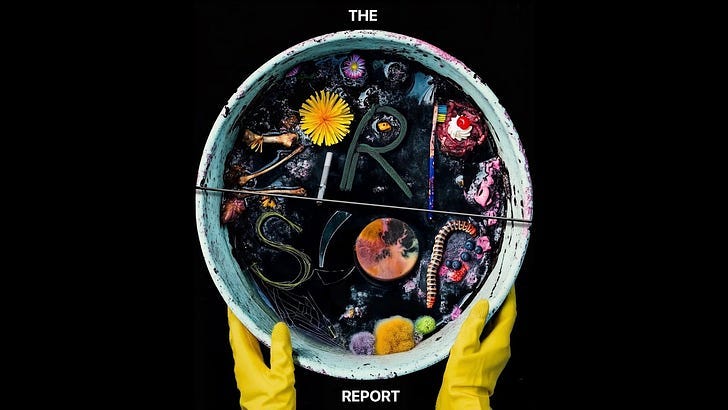
If culture could be transformed so completely by a monetary policy that conjured trillions of dollars out of thin air, then surely it can be reshaped again by an equally imaginary force, whether that’s collective belief in something better or the return of functioning institutions. Slop World isn’t permanent. It’s just a stage set we’ve mistaken for home.
This is an excellent breakdown of the state of the internet at the end of 2025. It’s not overtly Jew-wise, but I have no issues with Mr. Troemel’s analysis. All credits to the original author, this is just an elaborate repost.
Title: ZIRPSLOP REPORT, 2025
Author: Brad Troemel
Source: Youtube (2025-12-27)
Good afternoon, my name is Brad Troemel. No matter who you are, if you’re scrolling your phone right now, your feed is full of slop. AI nightmares, drop ship snake oil, OnlyFans goon bait, influencer brain rot, pointless life hacks, you name it. Slop is infinitely adaptable but always low quality. Everyone sees the slop, everyone knows it’s bad, but why? Why are we stuck in a cultural landfill of scams and junk?
It’s tempting to think this just happened by accident, like platforms suddenly lost control. But they didn’t. Slop isn’t a glitch, it’s the goal of a system working exactly as designed. This report asks, “Where did all this slop come from? Why build a service that worsens over time? And how did a handful of increasingly worthless apps come to shape how we talk, work, eat, date, and sleep?”
So join me as we dissect slop in all its forms and trace the thread from Washington’s policy desk to Silicon Valley’s content factory, all the way to the haunted images glowing in our palms. This is the ZIRP Slop Report.
Chapter One: ZIRP and Its Consequences.
The 2008 Crisis and the Rise of ZIRP
In 2008, America plunged into its worst financial crisis since the Great Depression. In the years leading up to it, millions were sold risky mortgages they couldn’t afford, while banks bundled those toxic loans into complex financial products and sold them to investors as safe. When the scheme collapsed, the results were catastrophic. Families lost their homes, millions lost their jobs, and major financial institutions failed.
Still there was hope. With Barack Obama newly elected, many believed an adult had finally arrived to clean up the mess left by his predecessor. But by the time Obama took office in January 2009, the most consequential response was already underway. Not from the White House, but from the Federal Reserve. That response was Zero Interest Rate Policy, or ZIRP. Much like tax cuts for the wealthy, ZIRP was sold as Trickle Down Economics.
How ZIRP Funneled Money into Silicon Valley
The idea was that making it easier for asset holders to borrow and invest would eventually rebuild the economy from the top down. Meanwhile, the middle class was punished for saving and forced to watch their wealth decline as the rich received free money to gamble with. Under normal conditions, high interest rates offer risk-free returns, typically 4 to 5% just by parking money in government bonds. But when the Fed slashed rates to near zero, those returns disappeared. ZIRP’s message to the wealthy was simple. You can’t just coast on interest anymore, you need to invest.
Spend the money you’ve saved or borrow from us for almost nothing, but either way, you need to feed this machine. To amplify this, the Fed launched quantitative easing, buying long-term bonds and mortgage-backed securities from banks to flood the system with even more easy money. Investors were nudged further out on the risk curve, moving from blue chip stocks and real estate all the way out to venture capital, which was seen as the highest return frontier. In the 2010s, this is how Silicon Valley became the preferred dumping ground for all the Fed’s easy money. Venture capital was already a hit-driven model. Investors expected most of the startups they invested in to fail, hoping for just one successful unicorn to return the value of the entire fund.
Blitzscaling and the Startup Boom
As Peter Thiel wrote in Zero to One, “The best investment a venture capital fund makes outperforms the entire rest of their portfolio combined. Therefore, a VC should only invest in companies that could someday dominate their industry.”
This created a singular goal. Every startup worth funding had to chase monopoly. In the 2010s, this was pursued through a strategy Netflix founder Reid Hoffman called blitzscaling, a high-speed, high-risk play where companies prioritize growth over profitability in an effort to outpace competitors. The mindset was summed up in Facebook’s now infamous motto, “Move fast and break things.”
While blitzscaling, startups branded themselves in dramatic, over-the-top ways, claiming to disrupt the world with what were often completely ordinary products.
Absurd Investments and Narrative-Driven Funding
Even companies outside of tech adopted the lingo, presenting themselves as software-driven platforms with exponential potential. We’re not a razor company, we’re a grooming platform. We’re not selling mattresses, we’re building an operating system for sleep. It’s not a water bottle, it’s a smart hydration node in a decentralized network. These exaggerated claims became a Silicon Valley cliché.
And while they appeared in podcast ads and subway posters, they weren’t really written for consumers. These over-the-top branding strategies were ultimately hopium for venture capitalists, the real audience these money losing startups needed to survive. Under ZIRP, even the most absurd pitch decks could land funding. Venture capitalists high on the narrative of innovation backed startups that mistook novelty for necessity. Think of a $400 wifi juicer, a Bluetooth salt shaker, a buy now, pay later plan for bagels. As the line between parody and product collapsed, nearly anything could raise millions of dollars before vanishing into the tax write-off abyss, leaving behind only snarky blog posts on Medium and warehouses full of unused juice bags.
The Upside-Down Economy of Losses
As value drifted from product to vibe, success hinged on a founder’s ability to project confidence. Pitch decks became mood boards full of sleek design, aspirational copy, and optimized for FOMO. Startups didn’t raise money to build things, they built narratives to raise money. While China poured concrete, the US posted TED Talks and sold diverse NFTs. Even startups with real products weren’t expected to make real profits. Uber spent over a decade losing more than $30 billion while working to destroy the taxi market, lobby lawmakers, sidestep regulations, and recondition consumer behavior.
Inspired by Amazon, the strategy was simple. Underprice competitors into oblivion, dominate the market, then you can dictate terms and raise prices once there’s no alternative. VC backed startups thrived under ZIRP’s regime of endless borrowing and subsidized speculation because their business models required sustained losses. If ZIRP pushed capital out of safe assets into risky bets, then startups were the perfect receptacle. They were shiny, promising, and bottomless. The result was an upside down economy where losing money became a sign of value.
Most blitzscaled unicorns posted millions, if not billions, in annual losses, all propped up by zero interest capital. In a normal environment, this would have been impossible, but under ZIRP, sustained losses became a badge of ambition rather than a mark of failure.
Chapter two. The Millennial Lifestyle Subsidy.
ZIRP’s False Recovery and Consumer Scraps
ZIRP didn’t offer a real recovery after 2008, just a consolation prize dressed up as one. In response to the crash, the Federal Reserve injected roughly 30 trillion into the financial system, most of which was absorbed by banks and asset holders.
The scraps that reached consumers became known as the Millennial Lifestyle Subsidy, a brief era when startups flooded the market with cheap prices to grab users and corner industries. This trickle down subsidy was visible everywhere. Discounted ride shares, coworking spaces, meal kits, streaming platforms and social media. Entire categories of millennial life were quietly underwritten by venture capital, and for a while, the placebo worked. Despite stagnant wages and rising living costs, a generation was lulled into a false sense of security by cheap luxuries they couldn’t actually afford, all made possible by ZIRP fueled pricing.
Impact on Fallen Professionals and Employment Illusions
The subsidy had the greatest impact on the fallen professionals of the 2010s, college-educated young people who moved to cities chasing careers, but ended up in low wage service jobs. Because the link between ZIRP and all these discounts were never made explicit, many mistook them as markers of personal success, proof they’d achieved adulthood. And it wasn’t just consumer comforts. For a smaller group, this illusion extended to employment too.
ZIRP era venture capital funded waves of tech startup email jobs, and HR, customer support, and brand strategy. These vaguely defined roles that were semi-remote, Slack heavy, and full of calendar invites offered a fleeting sense of white-collar stability.
A Day in the Subsidized Life
And who could blame millennials for thinking this was all normal? It’s hard to stay critical of something that’s embedded itself into every corner of your social, professional, and recreational life. Picture this. The year is 2014. You wake up late on a Casper mattress and call an $8 Uber to work. You’re a barista at Shopify’s office, excited for the free gourmet lunch.
On your commute home, you drown out the noise of a fight on the train with any Spotify song you want. Upon arrival, your roommates are debating which Blue Apron meal kit to make on the Burrow couch using a shared Misen knife set purchased from a podcast discount code. Everyone agrees to Venmo each other later, even though they know you haven’t paid them back in months. After dinner, you throw on your Everlane jacket and hop on a Bird scooter for a dollar. You meet friends at a cocktail bar inside of WeWork and get a free IPA, then discuss the latest clickbait article from Vice. Once you get back home, you crack a CBD seltzer you swiped from work and open the MoviePass app to book a movie you won’t attend.
You fall asleep to your Headspace app and think, wow, you’re 24, $73,000 in debt, but surrounded by amenities. Somehow, the future feels cautiously optimistic.
Weaponizing Perks Against Millennials
The millennial lifestyle subsidy didn’t convince anyone they were rich, it just let them pretend they weren’t poor. With wages stagnant and savings gone, millennials got rental access to goods and services they can no longer afford to buy outright. Can’t buy a car? That’s fine.
You can lease this one for 17 minutes. These discounted comforts softened the landing for a generation that was quietly falling from the middle to the working class. More perversely, the same perks once designed to placate millennials were later weaponized as proof of their entitlement. First, they were lured in with underpriced conveniences. Then when ZIRP’s recovery stalled, those same indulgences were held up as evidence that the failure was all their fault.
“Look at these spoiled kids complaining about wages. Maybe if they stopped ordering so much damn avocado toast, they could finally afford a mortgage.”
This became a generational script. Millennials weren’t just painted as financially reckless, they were framed as too emotionally fragile for adulthood. Some lead into that image, not as a criticism, but as permission to retreat into a softened life of comfort and nostalgia. That retreat was later used against them. The uneven effects of ZIRP were recast not as systemic failure, but as the fault of a generation addicted to ease and ungrateful for all the discount codes they received. Not coincidentally, this was also when privilege became the dominant lens for understanding inequality.
Instead of critiquing how power operated through institutions, millennials were taught to measure injustice by their access to comforts. Got wifi? A degree? Streaming services? Well, then maybe you should sit this one out. Structural critique was flattened into identity confession, and consumer behavior became yet another moral test to fail.
Every small pleasure, a $15 sushi roll or a free seltzer, became a source of silent shame.
Diluting Awareness and Erasing Theft
The message was clear. You can enjoy the perks, but if you criticize this economic arrangement, then you’re a hypocrite.
“Because if you were truly oppressed, then you wouldn’t have Spotify, right? You’d be living in a sewer listening to poop noises. You know, someone sufficiently miserable enough to earn the right to complain.”
Looking back at the failures of all three waves of economic populism in the 2010s, it’s worth asking, how much did the millennial lifestyle subsidy dilute its recipients’ awareness of just how precarious their lives were? How much did consumer guilt convince a downwardly mobile generation that they were merely temporarily embarrassed members of the middle class? After all, it’s hard to feel like you’re part of the 99% when you’re being chauffeured, even if your destination is the roach-infested two-bedroom rental you call home. By masking austerity as abundance and individualizing blame, the millennial lifestyle subsidy didn’t just dull political outrage, it erased the scale of theft. Though framed as a stimulus, ZIRP was a massive upward transfer of wealth to the exact same institutions that caused the 2008 collapse. In hindsight, there were countless better ways to stimulate the post-crash economy.
The Fed could have sent money directly to households. It could have bought and restructured mortgages. The Fed could have issued low interest loans to states for jobs, infrastructure, and public services. But instead, we got discount code scraps at the expense of meaningful reform.
What We Got Instead of Real Reform
For $30 trillion of taxpayer money, we got Uber Pool instead of high-speed rail. We got Airbnb cleaning fees instead of affordable housing.
We got metaverse expansions instead of public infrastructure. We got dog walking gigs on Rover instead of union jobs. We got two free therapy sessions instead of universal healthcare. We got income share coding boot camps instead of free public college.
ZIRP gave us private innovation instead of public institutions. To add insult to injury, many millennials went on to defend these subsidized companies as if they were the very public services they’d been denied. This is the thinking of the treatlerite, someone who, ashamed of their perks, reframes discounted conveniences as if they were basic human rights.
You see this thinking in DoorDash discourse where Treatlerites argue that on-demand cheeseburgers are essential healthcare, while critics point out that these conveniences only exist because apps underpay gig workers in local restaurants. Once you believe tech consumption is a human right, your loyalty shifts to the app, not the worker. And even now, with worse apps, higher prices, and more exploited labor, the Treatlerite defenses continue. You’ll see it in the replies.
“Actually, I need Uber Eats for my mental health and because I’m allergic to cooking.”
All argued as if gig platforms are public utilities and the federal government never had the funds to help in the first place. Ultimately, the millennial lifestyle subsidy didn’t just make people feel guilty for small comforts, it taught them to be grateful to austerity for not making their lives even worse.
Chapter three: Enshittification.
The End of Subsidies and Platform Decline
In hindsight, the fed couldn’t keep interest rates at zero forever, and venture capitalists would eventually demand returns. After COVID, as rates rose and VC funding dried up, the price of millennial lifestyle subsidies soared while quality collapsed. Uber got expensive, WeWork imploded, DoorDash added fees, Google declined, and Facebook filled with AI spam.
The illusion fell apart. Luckily for these startups, many had already achieved market dominance, clearing the way for the next phase of their life cycle, enshittification. As Cory Doctorow describes it, enshittification is what happens when platforms deliberately worsen themselves for profit. First, they prioritize user growth. Then they pivot to advertisers. Finally, they cater to shareholders, jacking up prices and gutting the staff that kept things functional.
Phases of Enshittification
What’s left is a broken platform that still extracts value from users who can’t leave. Each phase of this arc maps to a startup life cycle. First is the honeymoon phase, the blitzscaled, VC-flushed era of subsidized goods, over-the-top perks and small elite engineering teams. Workers are treated like rockstars, users are pampered. It’s a playground of optimism. Next comes IPO puberty.
To cash out stock options or prep for acquisition, a startup needs to show the potential to generate real profit. The focus shifts from users to advertisers, sellers, or publishers, whoever’s trying to reach the audience. The company hires analysts, HR reps and salespeople to signal that it’s mature enough to go public. Then comes maximum extraction. Once acquired or listed, the startup exists solely to generate profit for shareholders. CEOs are faced with two options.
They can either risk spending money building something new or squeeze money from what’s already there. Obviously, squeezing always wins. New apps stop shipping, engineers are replaced with cheaper H-1B visa labor, every feature is monetized, feeds fill with spon con, moderation collapses, usability tanks. The platform becomes a haunted mall. It’s hollow but technically still open. Enshittification is the inevitable result of every platform’s conflict of interest between user experience and profit.
Enshittification Across Industries
Google can show you what you searched for or whatever scammy SEO farm paid to be first. Spotify can recommend real music or shovel you AI sludge it doesn’t have to pay royalties for. YouTube can surface thoughtful videos or serve up reaction clips of people reacting to reaction clips. Amazon can show you the best product or hide it behind 10 pages of its own plastic knockoffs. But this isn’t just a tech problem, it’s everywhere. The same VC and private equity firms that back social media also bankroll film, TV, academia, publishing, art, even fine dining.
Our entire cultural life has been enshittified from lowly TikTok thirst traps all the way up to Ivy League op-eds. Take academia, for example. Its financial structure is so degraded that universities now squeeze students and faculty alike, raising tuition while slashing teacher pay. What remains are zombie institutions focused less on education than on enrollment numbers, campus amenities and administrative bloat. The university becomes a real estate investment firm with a diploma mill attached. Whether it’s a university, a record label or a social media app, the pattern is always the same.
Monopoly and User Trapping
Extract more, offer less, even if it means killing the host. The only thing restraining these companies’ greed is whether consumers have viable alternatives. That’s why monopoly was always the end game. Once the platform dominates the market, its users are stuck. Hate that Google image search is now a Redbubble graveyard? Too bad.
Miss Twitter’s old timeline? Well, then enjoy Bluesky with your five mutuals. Think Uber’s too expensive? Well, then go ahead and walk home after midnight. When there’s no competition, every platform becomes a hostage situation where users are forced to either stop caring about the shittiness or stop using the app, which is much harder to do once you’ve spent a decade becoming dependent on a platform everyone you know also uses. For social media, enshittification betrays their founding promise. Platforms like Myspace, Facebook and YouTube rose by telling users everyone had an equal shot at being heard.
Even when certain accounts started gaining fame, virality still felt like a mirror of collective taste. Users were told, “Okay, maybe you specifically won’t go viral, but you will be able to actively help who does become famous by liking, commenting and sharing their posts.”
That illusion is now dead. Users now see feeds shaped not by community interest, but by engagement-maxing algorithms. Everyone knows that platforms secretly boost specific accounts without explanation, leading users to cynically assume that the viral figures they’re shown result from back room manipulation or even government psyops. Users now feel like passive spectators trapped in a viewing experience just as top-down and opaque as the dusty old legacy media companies that digital platforms once promised to disrupt.
Dead Internet Theory and Final Stages
This sense of helplessness feeds into dead internet theory, a deliberately paranoid idea floated by the user illuminati_pirate. The theory claims that most of the internet isn’t real, but simply bots talking to other bots.
While exaggerated, it gestures toward a real phenomenon: most web traffic today is automated. According to the theory, this automation has now overtaken the human parts of the internet, too, such that much of the discourse we now witness isn’t really people talking to each other at all. On Facebook, anonymous pages churn out grotesque AI collages of mutilated children and patriotic statues. On Twitter, bots trade “yas queen” affirmations in endless loops. On Spotify, networks of fake ambient musicians flood playlists. On Kindle, auto-written novels appear beneath machine-made covers.
Though much of this eerie content likely began with a human prompt, it’s not hard to imagine a future where even that last trace of human authorship disappears, leaving machines to speak entirely to themselves. This is the final stage of enshittification, an internet hollowed out by finance where content is no longer made for anyone or by anyone, just endlessly circulated to feed metrics only machines can read. Human input becomes optional. Virality gets aside. The platforms that once promised empowerment have since become extraction machines, perfectly happy to incinerate their own user base so long as there’s one more quarter of growth to show shareholders.
Chapter four: Surviving Slop World.
Defining Slop and Brain Rot
If enshittification is a company operating at peak extraction, then slop is its finished product. It’s content designed to provoke endless engagement with no lasting meaning. Slop aspires to nothing greater than algorithmic appeasement, which means it can take on an infinite number of forms while staying consistently low-quality. In just five minutes of For You page scrolling, you’ll likely encounter some combination of AI-generated random sauce; oddly satisfying drivel; “It’s just a prank, bro” hooliganism; poorly disguised OnlyFans ads; pointless life hacks; hustlepreneur scam artistry; political rage bait; drop-shipped snake oil; threadbare conspiracies; stunning and brave libel; influencer to seed; or melodramatic nostalgia. The permutations are endless, but the outcome is always the same. There’s a popular misconception that slop is what happens when platforms lose control, but the opposite is true.
Slop isn’t a glitch, it’s the goal. Every major platform has a bonus system that distributes money based on metrics like reach, reactions, shares, and comments. In practice, it’s a slop subsidy. All the grotesque content you’re shown against your will isn’t accidental. It’s what the platforms are optimizing for: high-engagement, low-effort, infinitely reproducible content. Slop is what it looks like when the platform works exactly as designed.
Brain rot is the word most often used to describe the cognitive decay that results from hours of passively scrolling slop. It’s a mix of detachment, irony poisoning, and useless trivia bloat. Brain rot’s effects are paradoxical. People describe feeling both overstimulated and bored, lured in by whatever bait the slop dangled, only to feel let down the moment they’re done consuming it.
The Collapse of High and Low Culture
In a previous era, this disappointment might have dissuaded users from scrolling. That is, if they hadn’t already been numbed to it by the equally sloppy derivative culture upheld by even the most refined institutions. Academic journals publish jargon slop, art museums exhibit tax evasion slop, independent theaters screen Marvel slop. So, when you open your phone and see the slop you were guaranteed, at least it never pretended to offer sophistication. Its vulgarity can be mistaken for honesty. In Slop World, the line between high art and low culture collapses into a single overflowing trough of what we now call content.
But that grim recognition raises a more urgent question: how can people find or create genuine artistic meaning while suffocating in a slop-filled trough?
Coping Mechanisms: Hipster Strategies
Fortunately, even in the most barren conditions, I don’t think artistic meaning is ever truly destroyed. It just changes shape, adapting and mutating to whatever toxic environment it’s forced to inhabit. Of course, the most common coping mechanism Slop World’s residents adopt is to accept the utter passivity that slop so clearly demands. They doomscroll until they’re sufficiently distracted from work or mentally dulled enough to fall asleep. But for a smaller, media-savvy, aesthetically conscious crowd, passively accepting slop clashes with both their personal taste and public persona.
In a previous era, we called them hipsters. And since no better term has emerged, we can call them hipsters now, too. There are three popular ways hipsters have responded to slop’s omnipresence in an effort to find and create a more artistically refined existence online. These strategies are: slop curation, absurd slop posting, and building canons of prestige. Each has its strengths and shortcomings, but I’m ultimately sympathetic to all three for the simple reason that trying anything is better than giving up and drowning in the trough.
Strategy One: Slop Curation
First, let’s look at slop curation, which is the basis of every meme page online.
All curation allows the curator and audience to create meaning through recognizable patterns. Since most social media posts are shown by opaque algorithms, any meme page built around a clear theme offers a small but satisfying sense of control over the chaos. This desire for order is ultimately a search for meaning. By organizing slop by politic, aesthetic, or era, the goal isn’t just to understand the content, but to understand the conditions that produced it. Curation becomes a way to reverse engineer the machinery of cultural decay by mapping its waste. It’s a strategy familiar to anyone who attended middle school biology.
Despite whatever vaguely anthropological reasons a curated meme page may give for existing, every slop curator is ultimately a moralist. Those who sift through the trough to find unexpected moments of beauty suggests the better world we’re looking for has been with us all along. However, the vast majority of slop curation is instead a way of organizing cultural lowlights and granting a purposely critical audience to what we know as cringe.
All cringeworthy material generates its humor from cruelty, from mockery, from the audience having a better understanding of a cultural code the person being cringed at has failed or misread.
To intentionally subvert a code is transgression. By contrast, cringe occurs in the gulf between intention and outcome when misguided efforts are publicly observed and judged. The severity of that judgment and the comedy it produces depends on the power and unearned confidence of the person failing.
Cringe curation trains the audience post by post in what’s okay to mock and what isn’t. Meme pages become safe spaces for mutual judgment, where comment sections affirm a shared worldview. This indirect guidance helps the audience embrace the more ideal world the slop curator imagines. By presenting what’s unanimously judged as bad, they’re also coached into a collective belief in what’s implicitly good. This kind of critical reflection on the present as a way of shaping the future is what makes cringe curation so similar to trend forecasting, which also uses the pretense of anthropological study to let the forecaster project the kind of future they’d personally prefer to inhabit. Both cringe curating and trend forecasting are exercises in hyperstition, moralized attempts to meme a preferred reality into existence.
The trouble with cringe curating is that there’s never a point where you can fully remove every piece of slop out of the trough to organize it because there’s constantly new slop being hosed in and the bottom of the trough keeps sinking. The curator is faced with a dilemma. On one hand, they can follow their cringe theme into the depths of depravity in an effort to honestly depict the ever-worsening state of slop. However, in doing so, they risk blackpilling their audience by presenting their ideal future as less and less likely to come true. If things are always visibly getting worse, then what hope is there for the more ideal world being implied? On the other hand, the slop curator can draw a line at how low they’re willing to go to preserve some sense of hope.
But in doing so, they risk irrelevance by failing to reflect just how far the cringe has gone and opening the door for new accounts who are willing to go there, wherever there might be. By setting limits, the curator risks breaking their own cultural code that no slop is above critique, and in turn, risks becoming cringe themselves.
Strategy Two: Absurd Slop Posting (Echoic Brain Rot)
The second hipster strategy for living through Slop World is the knowing embrace of slop posting. With the collapse of faith and virality as something democratic, we’ve entered an era of abject absurdism.
The self-aware viewer disavows any responsibility for viral content, knowing they can’t create it or meaningfully vote on it even if they wanted to. In place of participation comes passive witnessing, a culture where memes emerge without reason, origin, or invitation. Viral memes now refer only to themselves as images that are popular because they’re popular. There’s no satire, no external joke, often not even a recognizable origin beyond the broadest age or location demographic. One day the meme appears, and from that moment forth, it simply exists. As such, the self-aware user treats each brain rotten meme as an alien artifact to be mock worship, not for what it means, but for the absurd fact of its unexplainable existence.
This mock worship is often performed collectively by reposting brain rot with the same reverence once reserved for world events, parodying the newsfeed’s breathless tone. In a culture where high and low have melted into a uniform sludge of content, pretending hawk tuah matters is a way of mocking the idea that anything does.
This kayfabe of awareness-raising urgency gives users an ideal stage for participating in a culture where the only thing worse than being cringe is being ignored.
Faced with a feed that assigns meaning at random, some users inject their own chaos back into the algorithm as a kind of memetic revenge.
They stack as many brain rot signifiers as possible into posts designed to overwhelm and reflect the absurdity of the platform itself.
This impulse reaches its most stylized form in core-core videos, which compile hyper emotional TikTok clips into mood collages that feel both profound and hollow.
Now, if you came of age during a time when viral content was expected to offer a relatable insight or a shared cultural truth, it would be understandable to reject brain rot memes and micro-celebrities as meaningless intrusions. And you wouldn’t be alone. Entire channels now exist to stage that awkwardness on camera, forcing random unc’s on the street to react to brain rot memes, showing their faces seize up in disbelief when forced to confront a younger generation’s visual chaos.
But what does it even mean to reject something that’s unavoidable? Memes are, by design, ubiquitous. To reject a meme is like rejecting the weather. So long as you use social media, and even if you don’t, these videos show you’ll be forced to interact with slop on some level. For the chronically online, acceleration becomes the only viable path forward. If meaning is unstable and participation is futile, the next best option is repetition, posting not to express something, but to remain visible.
Psychologists call this echoic behavior, a kind of mimicry without comprehension, often observed in early language development. You can imagine an infant repeating, “Do you want a cookie?” back to an adult not to request a cookie, but to provoke interaction. Just as you can imagine someone commenting, “Skibidi sigma huz,” beneath a George Droid video. The child, like the commenter, doesn’t have a specific intention beyond curiosity. A post like John Pork gooning the ahki way doesn’t mean anything. It just proves you’re still plugged in, still playing, still part of whatever this is.
These echoic experiments are often more fun than the total collapse of meaning might depressingly suggest. Brain rot descends from weird Facebook and MLG-era memes, formats that were fun precisely because they asked so little.
No pressure to be clever, no need to get the reference, no emotional or political investment. That disposability was the appeal. In a digital landscape shaped by fully optimized identities, brain rot offers a rare permission to post without thinking, to laugh at something that barely makes sense, then watch it vanish without consequence. At the risk of over-theorizing the oeuvre of John Pork, it’s worth noting that even the dumbest memes tend to follow patterns of repetition and compulsive display that resemble older forms of artistic expression. Like brain rot, graffiti tags were often meaningless to outsiders. They were random handles and cryptic marks.
But explanation wasn’t the point. The tag was just a way of taking up space in a hostile environment. Graffiti artists got up not to communicate depth, but to prove they couldn’t be ignored. Online, the same logic applies. It’s not about being understood, it’s about being seen, if only for a second before the algorithm replaces you with another ad. Mimicking slop becomes a performative way of shrugging at the cultural conditions that produced it.
You join in not because you earnestly believe that “Tra la ler lo tra la la” is from Ohio, but because disbelief is irrelevant. Echoic brain rot lets you pretend you’re in on the joke, even when there’s no joke to be in on. For all its short-term fun, brain rot admittedly doesn’t offer anything lasting. No one’s telling their grandchildren about Grimace’s low taper fade.
Strategy Three: Building Canons of Prestige
That absence of legacy fuels the third hipster strategy for surviving Slop World: building a prestigious canon of culture that exists beyond the trough. If all slop, whether self-aware or not, is disposable, then the only way out is through culture that aims to endure.
Prestige TV, auteur cinema, risky solo shows. The hope is that somewhere, someone is still making art that matters. Prestige promises meaning in a culture built for disposability. What seems like the contradiction of our time, the idea that everyone has infinite, instantaneous access to whatever content they want and yet no one cares to watch any of it, starts to make more sense when you zoom in on the word “content,” which implies that everything now available is cheap, generic, and disposable. Prestige, by contrast, is expensive, distinctive, and lasting. This craving isn’t new.
Canon-building has long been central to hipsterdom, which always walked a line between gatekeeping snobbery and the sincere urge to evangelize the overlooked. What’s changed is the urgency. In the face of enshittification and the loss of faith in cultural institutions, prestige building feels less like a hobby and more like an emergency rescue mission to salvage meaning from the wreckage. Online, much of prestige-building is done through nostalgic historicization.
Every hipster corner of the internet has its own main character, biblical text, forbidden film, canceled genius, misunderstood flop, foundational meme, and golden era. These fragments get reassembled into a kind of secular canon, not enforced from above but constantly gestured at through references, playlists, screenshots, fancams, think pieces, and video essays. It’s not just accounts with Greek statues as their PFPs. Every digital subculture is attempting to return to its own prestigious past. Newly created culture, on the other hand, is put through a gauntlet. Whenever a project threatens to enter the canon of prestige, hipster corners of social media quickly turn into art media seminar classes where praise, over-analysis, and preemptive backlash all compete.
Together their debates become a grassroots prestige filter. Around release dates, the discourse becomes so frenzied that participants even avoid social media for fear of spoilers, arguably the only force strong enough to get the chronically online to log off. But this desperation also warps the discourse. Evangelists become self-indulgent stans, elevating middling projects. At the same time, gatekeepers criticize every project for failing to address an ever-expanding checklist of topics that, in a healthier cultural ecosystem, could be addressed by many other available TV shows, films, and exhibitions. The few culturally significant works that rise above the slop are unfairly expected to be everything to everyone.
The fussy gatekeeper demands to know, “What does Severance have to say about the war in Ukraine? Why hasn’t The Rehearsal addressed asexuality? Why doesn’t this apple I’m eating taste like an orange?” All this raises an obvious question: If audiences love prestigious culture so much, why isn’t there more of it created? One answer is its limited audience. Prestigious visibility on Twitter can mask its actual reach. I Think You Should Leave rightfully dominates the discourse as one of the best comedies of the past decade, but its latest season didn’t even crack Netflix’s top 3,000 most-watched titles. Meanwhile, certified top-five hits like The Night Agent or Dear Child barely register in hipster discourse.
People often mistake projects that perfectly reflect the zeitgeist for being the engine moving it, just as they mistakenly believe the impassioned volume of their discourse extends beyond their own echo chamber. Another reason there aren’t more prestigious projects is profit. Ironically, today’s cultural institutions, from movie studios to art galleries, aren’t actually geared to create new culture, but to monetize existing IP. As Andrew deWaard notes, they now specialize in derivative media, endlessly recycling proven content across formats, which means the only kind of new culture they’re interested in producing is the kind that’s preemptively built to be licensed, merchandised, franchised, rebooted, gamified, theme-parked, TikTok soundtracked, adapted into streaming miniseries, bundled into synergy slates, and squeezed into cinematic universes. Most new culture isn’t made to be a singular achievement, it’s made to be interoperable. Any profit that doesn’t go directly to shareholders is either used to buy up smaller competitors or to automate content production.
The rare prospect of developing new, potentially prestigious projects is outsourced to social media where artists are left to self-fund and compete with each other for virality in an environment that, once again, favors legacy IP. It’s not that cultural institutions have abandoned prestige entirely. They’ve simply tried and failed to scale it. In a previous era, institutions accepted that prestige wasn’t for everyone. They funded difficult art on principle even when it alienated the public, and wore that alienation as a badge of honor. Museums, indie studios, and networks like HBO or Z Channel built their credibility on this self-sacrifice.
It was a kind of virtue signaling in the truest sense. It was a moral commitment to difficult, often unpopular work. But in late-stage enshittification, that model has been replaced. Cultural institutions have learned they can signal virtue without embracing risk. Today it’s more profitable to produce slop geared towards mass appeal than coat it in the aesthetics of progress.
Instead of funding hard-to-watch films or strange ambitious exhibitions, institutions now demonstrate their moral standing through maximally inclusive, trauma-focused, socially affirmational content. In other words, they figured out how to have their virtue and sell it too. The result is a lot of culture that poses as prestige without ever achieving it. Prestige becomes a mood board of aesthetic references, moral themes, and tonal cues recycled from past successes, often matching the production values of serious art without the ambition or difficulty that once defined it. By trying to manufacture prestige at scale, the culture industry ends up parodying the very thing it’s chasing. Once there was the promise that digital life would be a commons where people could express themselves and support their community.
ZIRP turned that promise into a pipeline, flooding culture with capital, warping art into slop, and rebranding austerity as abundance. But even in the enshittified wreckage, people didn’t fully give up.... every slop curator mapping the trough, every slop poster embracing absurdism, every prestige builder preserving their cannon. Each one acts on the same underlying belief, that culture can be more than whatever the algorithm spits out. And if culture could be transformed so completely by a monetary policy that conjured trillions of dollars out of thin air, then surely it can be reshaped again by an equally imaginary force, whether that’s collective belief in something better or the return of functioning institutions. Slop World isn’t permanent. It’s just a stage set we’ve mistaken for home.
We already watched one world dissolve and another take its place. There’s every reason to believe this one will too.
“Teddy told me that in Greek, nostalgia literally means the pain from an old wound. It’s a twinge in your heart, far more powerful than memory alone.”

Good premise but article should be shorter, I sense the hand of AI in this.