

Quote from JOHANN GOTTFRIED HERDER (1744—1803)
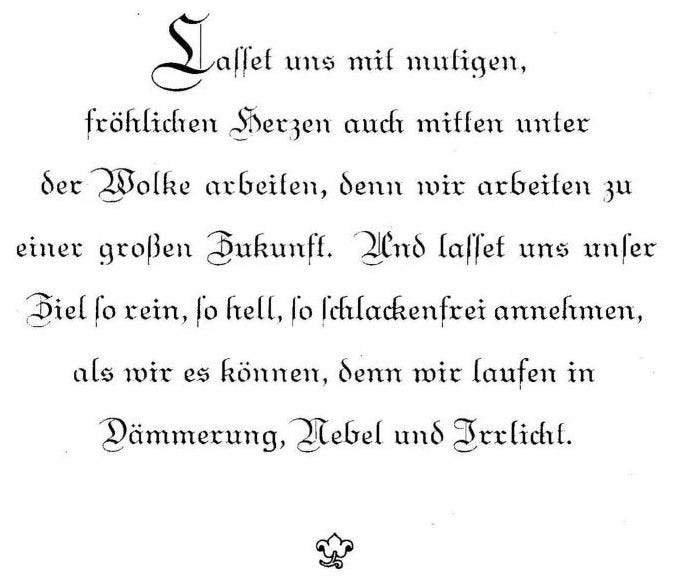
Let us work with courageous and cheerful hearts even in the midst of the cloud, for we are working toward a great future. And let us accept our goal as pure, as bright, as unalloyed as we can, for we are proceeding in twilight, fog and will-o'-the-wisp.
Lass uns mit möglichst fröhlichen Herzen auch mitten unter der Wolke arbeiten, denn wir arbeiten zu einer großen Zukunft. Und lasset uns unser Ziel so rein, so hell, so schlackenfrei annehmen, als wir es können, denn wir laufen in Dämmerung, Nebel und Irrlicht.
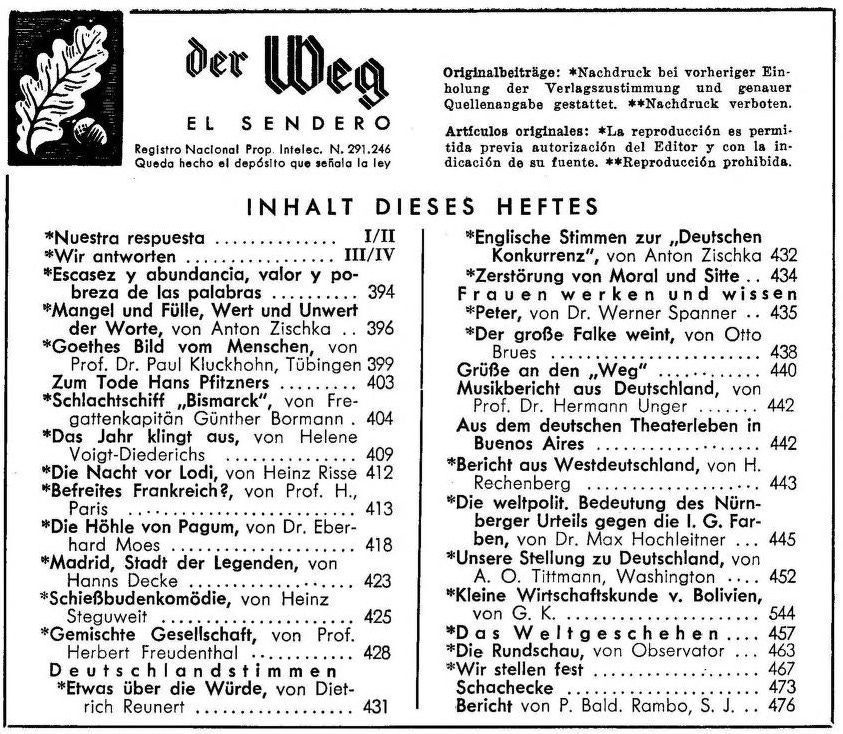
Table of Contents
Pages: 393-476 [Scan LINK]
[BELOW] We remain a monthly magazine!
de: Wie bleiben Monatszeitschrift!
[BELOW] We Answer
es: Nuestra respuesta (pp. I/II)
de: Wir antworten (pp. III/IV)
[Article LINK] Quotes and Letters
On the Death of Hans Pfitzner
de: Zum Tode Hans Pfitzners
Greetings to “Der Weg”
de: Grüße an den „Weg“
[Article LINK] Scarcity and Abundance, Value and Poverty of Words by Anton Zischka
de: Mangel und Fülle, Wert und Unwert der Worte
es: Escasez y abundancia, valor y pobreza de las palabras, translated by G. Friedl
[Article LINK] Goethe's Image of Man by Prof. Dr. Paul Kluckhohn, Tübingen
de: Goethes Bild vom Menschen
[Article LINK] Battleship “Bismarck” by Fregattenkapitän Günther Bormann
de: Schlachtschiff „Bismarck“
[Article LINK] The Year Winds Down by Helene Voigt-Diederichs
de: Das Jahr klingt aus
[Article LINK] The Night Before the Battle of Lodi by Heinz Risse
de: Die Nacht vor Lodi
[Article LINK] Liberated France? by Prof. H., Paris
de: Befreites Frankreich? (pp. 415
The Cave of Pagum by Dr. Eberhard Moes
de: Die Höhle von Pagum (pp. 418
Madrid, City of Legends by Hanns Decke
de: Madrid, Stadt der Legenden (pp. 423
Shooting Gallery Comedy by Heinz Steguweit
de: Schießbudenkomödie (pp. 425
[Article LINK] Mixed Society by Prof. Herbert Freudenthal
de: Gemischte Gesellschaft
[Article LINK] Voices of Germany [de: Deutschlandstimmen]
Something About Dignity by Dietrich Reunert
de: Etwas über die Würde (pp. 430
English Voices on the “German Competition” by von Anton Zischka
de: Englische Stimmen zur „Deutschen Konkurrenz” (pp. 432
Destruction of Morality and Customs
de: Zerstörung von Moral und Sitte (pp. 434
[Article LINK] Women’s Work and Wisdom [de: Frauen werken und wissen]
Peter by Dr. Werner Spanner
The Great Falcon Weeps by Otto Brues
de: Der große Falke weint (pp. 438
Music Report from Germany by Prof. Dr. Hermann Unger
de: Musikbericht aus Deutschland (pp. 442
From German Theater Life in Buenos Aires
de: Aus dem deutschen Theaterleben in Buenos Aires (pp. 442
[Article LINK] Report from West Germany by H. Rechenberg
de: Bericht aus Westdeutschland] (pp. 443
[Article LINK] The Geopolitical Significance of the IG Farben Trial by Dr. Max Hochleitner
de: Die weltpolit. Bedeutung des Nürnberger Urteils gegen die I. G. Farben
[Article LINK] Our Position Toward Germany by A. O. Tittmann, Washington
de: Unsere Stellung zu Deutschland] (pp. 452
[Article LINK] A Brief Economics Primer on Bolivia by G. K.
de: Kleine Wirtschaftskunde von Bolivien] (pp. 454
[Article LINK] World Events
de: Das Weltgeschehen] (pp. 457
[Article LINK] The Noticing
de: Die Rundschau
[Article LINK] We Note!
de: Wir stellen fest] (pp. 467
Chess Corner
de: Schachecke] (pp. 473
[Article LINK] Travel Experiences by Father Balduíno Rambo, S.J
de: Bericht

We remain a monthly magazine!
Due to the paper shortage in Argentina, contrary to our intentions, we will be forced to abandon our bi-weekly publication starting July 1. We thus remain a monthly magazine as we have been, but we will expand the individual issues and allocate 104 columns to each.
Not only because of this expansion, but above all because of the continuously rising costs, we are increasing the price of the issue to m$n3—starting with the next issue.
The expansion will primarily benefit the literary aspect of the issues. We have meanwhile become the leading German magazine abroad. This should spur us on to continue serving as the guiding force through the existing and upcoming challenges in all matters of universal relevance. Beyond the German and Austrian personalities you are familiar with, many notable intellectual leaders of our people in all fields have again placed their collaboration at our disposal.
Thus, we now have all the resources at our disposal to advance our work further everywhere on earth. We therefore call upon each of our readers: Help where it is still lacking, and maintain the connection with us as before.
We further inform our readers in Brazil that we felt compelled to terminate our representative relationship with Mr. Godofredo Entres, since the connection was no longer tenable for the reputation of our magazine.
In connection with the news of a distribution ban on our magazine in the American Occupation Zone (of Germany) and in Austria, spread by some press agencies, we refer to our Spanish-language lead article and to our response note in the Freie Presse, Buenos Aires, dated May 29, 1949.
With warm regards,
THE EDITORIAL STAFF
We respond!
For officially unfounded motives, the distribution of our magazine Der Weg was banned in the American Occupation Zone (of Germany) and in Austria. The announcement of these measures by the agencies The Associated Press and United Press was viewed by some newspapers as a signal for a well-considered and centrally directed defamation campaign against Der Weg. Certainly, various questions are pressing upon our readers, the answers to which we wish to summarize in three points based on our knowledge of the underlying connections.
1. What are the real causes of this measure?
Der Weg is a young and successful magazine that was founded in July 1947. Through its high cultural and literary level, through truthful independent reporting, through the collaboration of renowned international figures, through sensational special reports, in short, on the basis of intellectual, editorial, and technical achievements, it experienced a unique upward development. This made it possible to increase the circulation tenfold within two years, and it was designated throughout the world as the “most significant post-war publication in the German language”. This, along with the fact that the number of advertisers grew steadily and the circle of readers and contributors expanded evenly, caused unrest to haunt the circles of the newspaper Argentinisches Tageblatt, published in Buenos Aires in German, whose circulation figure was surpassed by Der Weg, before an ascending “competitor”.
When, in the March issue of 1949, the supplementary issues and in the following issue, the biweekly appearance were announced, it seems that in the mentioned circles it was decided to “damage the competition”. However, since this did not seem possible through journalistic outbidding, they resorted to the foul methods of “politicizing the business” and dragged the economic and competitive struggle onto the political level. The cheapest and today effective means is that of the accusation of “Nazism”.
Without waiting for the appearance of the announced contributions, they hurled this reproach at Der Weg, assuming that this would damage its reputation in the world. In an article in the Argentinisches Tageblatt of May 31, 1949, the author expressed this with the words: “It is time to deal with this publication . . . ”, not to orient oneself, as he claims, about the spirit (that would have been noticed much earlier in today’s sensitive world with a real “Nazi organ”!), but to find the starting points to damage the competition economically with political arguments. They acted alarmed and thoughtlessly, and embarrassed themselves accordingly. They mentioned articles that never appeared or were not planned in this way, while, in contrast, they did not mention those articles that had already appeared.
From Hanna Reitsch, no contribution had appeared at all; it was merely an excerpt from a private letter that had been published, in which she turned against deliberate falsifications.
The accusation of “Nazi tendency” on the basis of an alleged “collaboration” of Otto Skorzeny is baseless and silly, since the planned report on the liberation of Benito Mussolini was written with the knowledge of the United States military government and distributed by the agency Agence France-Presse and since it had been published before in a Swiss magazine and in an Argentine evening newspaper among others.
To impute political intentions to the planned instructive travel report by Colin Roß is nonsensical.
In continuation of the slanders, they also tried to construct a “Nazi organization” around Der Weg and rose to the following sentence:
“It is impossible that it [the magazine!] covers even the printing costs from its own revenues. One can therefore calculate where the amounts required for financing come from.”
Argentinisches Tageblatt, May 2, 1949.
This claim is a characteristic and well-known intrigue motif. Der Weg sustains itself, like all magazines, through the revenues from subscription and advertising fees, as also emerges from the bookkeeping. In the above-mentioned article, the author himself admitted that he does not believe in the building of a “party organization”. We understand well to what extent, besides competition, professional envy may have played a role in this maneuver, since we were able to bring sensational first publications that every press organ would have taken over with the greatest propagandistic effort if they had been offered to them. Furthermore, in the course of this unclean campaign, they tried to spread the idea that Der Weg would have been brought illegally to Germany, even disguised in food crates! However, the fact is that as early as August 1948 the press office of the local United States embassy was officially informed of the distribution in Germany, that for months the issues went as printed matter to Germany and Austria, about which the postal records provide information, and that for the official distribution planned from July in Germany the corresponding representative was named in the first issues of 1949.
The press police office in Graz issued an express certificate that there is nothing to object to against the distribution of Der Weg. This would not have happened if one had been dependent on the use of smuggling routes! Thereupon, the conscious circles attempted to defame the representative in Munich; however, the highest United States certificates attest to his impeccable character. Finally, the competitive envy revealed itself in an article in the Argentinisches Tageblatt of April 31, 1949—the claim of an alleged “Nazism” was anticipated in the explanations and set up in the headline, but in the article could not be developed at all and moreover was led ad absurdum by the author’s own findings and conclusions. To crown this smear campaign, two respected Argentine daily newspapers were drawn into the game, one of which published a corresponding original contribution on this topic in its edition of June 1, 1949, while the second did so on June 6, 1949. We deeply regret that these two significant newspapers, which enjoy general respect on the basis of their rich reporting, became victims of such a murky and uncollegial maneuver.
The author of the first commentary was unfamiliar with Der Weg. This is evident, among other things, from the fact that he did not know the name of our magazine, El Sendero, as it is clearly readable on every title page, and designated us with El Camino. The true authors of the second commentary become clear from the fact that their own commentary of the Argentinisches Tageblatt was taken over almost word for word. We assume that these two statements by serious Argentine newspapers are not based on malice but rather on the justified intention to reprimand an allegedly “anti-democratic-Nazi” magazine, for which they had to hold us accountable based on the mentioned slanders and consciously false information. We hope that through our explanations, the true facts will become clear to both newspapers. However, the most crucial aspect of the entire maneuver was the deliberate provision of false information to the United States occupation authorities, which facilitated the implementation of the distribution ban in parts of Germany and Austria.
2. How is such a measure compatible with the claim of democracy?
Our evaluation of German and European events and conditions naturally deviates in many ways from that of the occupation authorities, for no occupying power ever grants the occupied country free expression of opinion. Even less would this be expected from a military occupation government. It gives food for thought when, simultaneously with the establishment of freedom of thought in the Bonn Constitution [Basic Law], the spiritus rector of this constitution negates it with the distribution ban of a magazine. But no democracy can deny the principle of intellectual freedom, and if differences of opinion among people who have nothing to hide should even be grounds for hatred and personal attacks, every democratic development will be stifled in the bud.
We count on the insight of those responsible when we assume that, after clarification of the real facts, the order will be reversed. One thing can be said with certainty: if the free development of Der Weg is prevented in a country, this is irrefutable proof that one is far removed from the realization of democratic conviction.
3. How do we stand on this?
In the July 1947 issue of Der Weg, we presented our guidelines. We still stand by them today. We have always acted in full compliance with the law on an openly defensible intellectual level, as expressed by all Argentine statesmen to date and reflected in corresponding decrees. As Argentines of German descent, we have conveyed to the world both an accurate understanding of Argentina and South America in enlightening and, in some cases, fundamental publications, and on the other hand, tried to bring closer to it the problems and necessities of Europe and Germany. To impute secret or “Nazi” intentions to us is absurd and proves not only a lack of knowledge of our work but also reveals the evil intention. We have been able to offer our large readership the most significant German-language literature, featuring original contributions by first authors. Our essays from the fields of art, culture, and science have aroused the liveliest interest in international circles and have been reprinted in various publications.
Few other contemporary magazines bring together such a select group of international collaborators across all fields of the arts. Countless letters of recognition and congratulations from international researchers, scientists, university professors, poets, writers, and artists (we mention only the deceased Hans Pfitzner) are available to us. None of these would have made even a single pen stroke for a “Nazi organ”!
In a large Argentine evening newspaper both the experience reports of Otto Skorzeny’s as well as Joseph Goebbels’ diaries were published; in newspapers of the United States almost daily reports of a German prince of North American citizenship well-known in Catholic circles [Hubertus zu Löwenstein] are published, whose sharpness in criticism of the United States occupation power can hardly be surpassed; a well-known Swiss daily newspaper [Neue Zürcher Zeitung] was banned in Germany some time ago—it is edited by a liberal, esteemed Swiss National Councilor [Willy Bretscher] . . . No person in the world would come to the thought of making the reproach of “Nazi propaganda” to one of these press organs or authors! —All contributions published by us are signed by the authors, and suggestions and collaboration came to us from the most diverse circles, independent of parties and confessions.
“Sire, give freedom of thought!” is the word of a great German poet [Friedrich Schiller] to Napoleon Bonaparte I. This word expresses the demand that has been raised repeatedly since the inception of the human state order. The great reproach made to politically authoritarian states culminates in the patronizing of areas of life and knowledge, and the resulting measures of book and teaching censorship; press and radio restriction; in short, the ignoring of freedom of opinion. This was therefore firmly anchored in all truly democratic constitutions of our age. In the United States, a magnanimous freedom prevails in this sense, and the same may be said of Argentina. In the spirit of this intellectual freedom, Der Weg is aware of its responsibility to act as a purifying and clarifying force in the current confusion of minds and to honestly open the door and gate to all constructive forces and opinions.
Only where clarity and cleanliness prevail can the good soul forces thrive, but in the dark chaos of disorder, the climbing plants of decomposing amorality proliferate. The soil of Argentine generosity and freedom, today more than ever, is the epitome of a true democracy for Europeans, and the forces of Argentine history, in which the struggle for ultimate intellectual values found expression, help us to solve this task in the freedom and dignity of our own thinking and thus contribute to the longed-for world peace.
Editor-in-Chief: Eberhard Fritsch. Editor: Gustav Friedl.
At Dürer-Verlag, Buenos Aires. Editorial Office: Casilla Correo 2398, Sarmiento 542, T. E. 34-1687. Printing: Imprenta Mercur, Rioja 674, Buenos Aires.
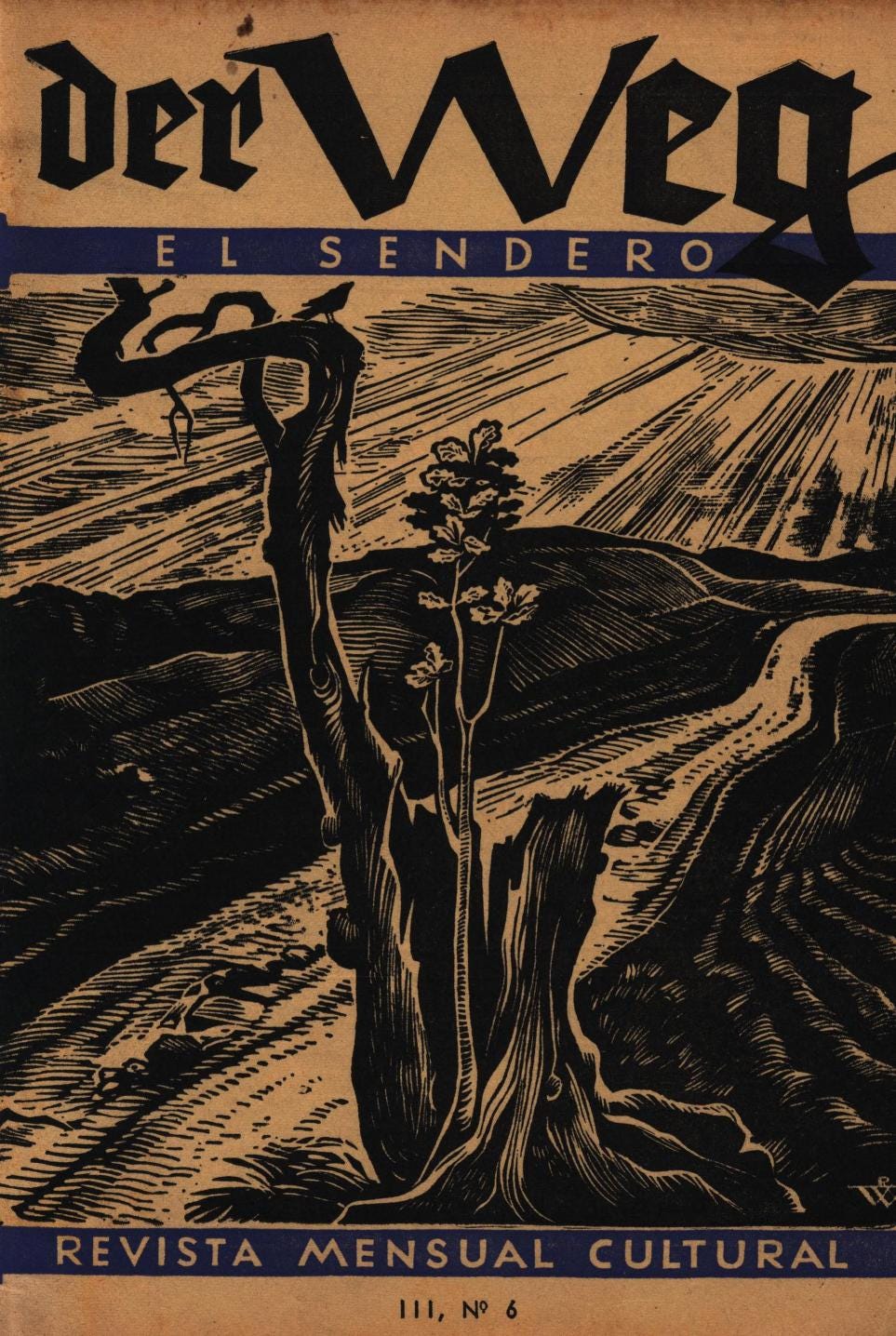
The cover image is a woodcut by Rudolf Warnecke, Dinkelsbühl, November 1948.
No responsibility is taken for unsolicited manuscripts. The Way appears on the 5th of each month.
Printed in Argentina.