Conversation with the Reader, March 1954
Written to Der Weg, 1954, Trans. by Dan Rouse 2026

Four letters from Der Weg readers:
August Haußleiter defends postwar German nationalists’ essential contributions against Gerhard B.’s criticisms, warning that associating with disruptive elements risks undermining hard-won progress under occupation.
Karl Heinz Priester validates Gerhard B.’s critiques of nationalist infighting but contextualizes them amid Allied restrictions and infiltrations, urging a shift to strategic political planning for future unity.
A German doctor in Syria eyewitnesses the 1948 Haifa massacre and the Arab expulsion by armed Jews, detailing brutal atrocities and desperate sea rescues aboard the steamer Grimani.
A Cairo reader attributes Kenya’s Mau Mau uprising to British forced recruitment for the Malaya wars and communist agitation, noting Arab sympathy tied to Nile security against colonial threats.
Original Title: Gespräch mit dem Leser
Attributed Author: multiple, write-in contrubtions.
“Der Weg” Issue: Volume 8, Issue 3 (Mar. 1954)
Page(s): 218-222 [Scan LINK]

Conversation with the Reader
The reader’s letter from Gerhard B. from Nuremberg in the Jan. 1954 issue, page 71, elicited numerous responses. We are publishing excerpts from two of them today. The first is from Mr. August Haußleiter, the leader of the “German Community” in Munich and a Bavarian State Parliament member; the second is from Karl Heinz Priester, the first chairman of the “German Social Movement” in Wiesbaden.
Dear Mr. Fritsch!
Regarding the “Letter from Nuremberg” that you enclosed for me, I may offer a few simple remarks:
Whoever advocated for the national cause in Germany since 1945 could expect nothing other than trials, convictions and defamations of every kind. Most unbearable were those people who did not grasp at all what the few outposts of the national cause actually had to accomplish. The entire intellectual-political structural transformation that has occurred in these years since the defeat in West Germany is unthinkable without the few national spokesmen. Here I must speak for all those who have stuck their necks out and who are being insulted in this pamphlet in a filthy and utterly base manner. If it were not the editor of Der Weg who had sent me this rag, then I would have declined to engage with the pamphlet. I briefly experienced the national scene in Nuremberg last Sunday at the Reich’s founding celebration of the “Gray Front.” What do you believe the comrades gathered there would have said to a letter of this sort? The letter writer claims that the previous national exponents only attacked each other, which is not true at all. I know Nuremberg because it is my hometown. Thus I ought to know the 160 men of whom he speaks as well. Such a group could not have remained secret if it had fought politically with open visor. There is only one explanation: In Nuremberg a now prohibited party had a few unfortunate figures who never appeared openly. Perhaps the tone customary there was as asserted here. The other national groups and soldiers’ associations that exist in Nuremberg take a clear, clean and resolute stance, even if occasionally, as may happen on this earth, one dispute or another comes to light that is then settled in open comradeship. When we appeared there for the first time, our first two assemblies were broken up by the communists. Today no such attempt is risked any longer. Had your letter writer, in whatever national group and in whatever association, participated in those confrontations as a comrade among comrades, then he would not sketch such an absurd picture that can only be meant to produce discouragement on the margins of the national camp. Such political amok-runners only supply the common political opponents with propaganda material and make all possible adherents of the national cause uncertain from the outset. Rudel has likewise been attacked and drawn in here in the same way, and he can count on us always having stood up for him. But if Colonel Rudel should believe he ought to work together with people of this sort, then he would endanger everything that has been achieved in constructive work so far, and he would himself quickly create a chaos that would exceed everything the S.R.P. has accomplished. Then he would not serve the national cause but extend the path of suffering of the national forces through yet another transitional phase. That would be all.
We will do what is necessary here to prevent new misfires. I greatly regret that we cannot discuss these matters orally. Here I can only warn you against a superficial consideration of these matters. I cannot expect of the post-war Germans that they have even a modest respect for the idealism of the few outposts who give up everything—possessions, health and even their reputation—in order to be able to remain loyal to their volk. I cannot expect that anyone today who cheerfully strikes at the so-called “incapable splinter groups” forms any idea of the real severity of building a freedom movement in an occupied territory. It is much cheaper to charge the misery of a first unsuccessful election to the account of the few men and women who had the courage for the first attack under unspeakable conditions. But what I can and must do is this: to warn against obvious errors that must inevitably arise from a frivolous assessment of the situation. You permit me at this point to state my opinion, unconcerned and frank, so clearly that something of what cannot be said here should also resonate.
With my best greetings! Yours,
August Haußleiter.
Wiesbaden, Feb. 8, 1954.
Here I may now go into the letter published under the bar “Conversation with the Reader” of Nov. 24, 1953.
You are right—this letter contains many truths, and one could say it is in essential parts also written from my heart.
Yet after multiple readings of the letter, I gain the impression that Gerhard B. tried too hard to reproduce the “outer face” as the national opposition displays it up to the present. Therefore it seems right to me to enhance the value of the view taken by B. by letting him and the readers of his letter take a little look “behind the scenes” of the present activity of national forces in residual West Germany. I believe that only then can the sharp sketches of the situation receive their proper frame for both Gerhard B. and for all friends who practice criticism out of an honest readiness to act.
I may state at the outset that I must count myself as belonging to the circle that from the hour of its “denazification” in March 1948 onward has spoken out openly against every arbitrariness toward the powerless fatherland.
At first the regulation applied that every political organization had to be licensed by the “liberators.” With that alone the development of a national opposition on a broader basis was thereby excluded until 1949.
In this time all those lone fighters who hung their last pennies on it, in small writings and hand copies, often without name indications etc., to protest against the post-war injustice, earned great merits.
Only at the end of 1949 did it become possible to appear openly in very cautiously chosen words. The countless groups forming since then that stepped forward in constant attacks against the injustice done to Germany were always carried only by a few men respectively. Not always were they such as had a clear and considered plan to show. They were men whom the distress had warmed the heart.
The economic distress, the aftereffects of the currency reform and the harassing treatment of the returning front soldiers as well as the debasement of deserving state servants to alms recipients contributed substantially to the speakers appearing especially in the so-called American and English zone often receiving strong approval. Yet soon three particularly essential measures or features became perceptible:
1. Both the neo-Weimar system parties and the occupying powers infiltrated every emerging national organization. For this they chose above all such compliant individuals who once held an office in the mass organization of the N.S.D.A.P. These attempted, by highlighting their earlier functions, to substantiate their special abilities and usually understood very quickly how to get themselves elected into a leading function. In reality they were nothing other than paid provocateurs and agents who reported every plan of the oppositional group to their employers.
2. Two world wars and two money devaluations as well as occupation periods, accompanied by the greatest economic distress, had made a large part of the German volk completely disheartened and indifferent toward the political events, so that our struggle was taken up only by a few idealists, all impoverished and hunted. Most lacked the means to travel beyond their local area and to make connection with comrades who had stood up against the system in their residential district. The (today still unchanged) prevailing censorship made it possible for the “liberators” and their helpers called to “government” to completely monitor the postal traffic and to lay disruptive mines against every common planning of like-minded people. Thus many of the lone fighters and groups were either worn down by the sending of “demolition commandos” into their assemblies and having the police play handyman, or were ground down by interrogations and court proceedings. Where this did not help, economic persecution was practiced.
Against this terror many of the fighters did not hold out for long.
The systematic undermining of every national opposition group as well as the repeatedly occurring disruption actions and slanders led to a condition of mistrust of each against each. And precisely therein lay the intention and success of the ‘45ers!
3. Both the Adenauer coalition (C.D.U., F.D.P., D.P.) and the Marxist S.P.D. used their means abundantly to prevent a self-recollection of our volk. From 1950–1953 motorized and well-financed envoys of the parties were sent who in every county, in every city and in the villages looked carefully for a “penitent” former N.S.D.A.P. functionary. These they sought and managed to win over. The higher his earlier rank was, the more joyfully he was greeted as a “returnee to democracy.” This “house Nazi” of the system parties was then the one who brought the circle of people of his trust and “enlightened” them that the “right-radicals” were only disturbers who threatened to prevent a liberation and social pacification of Germany—or probably stood in contact with the East.
It would lead too far to occupy oneself with the countless groups that had stepped forward since about 1948–49 with a confession to the nation, to the Reich and then disappeared. The reasons for their failure have for the most part been cited previously.
If Gerhard B. expresses his schadenfreude so openly that he felt on Sept. 6, 1953, no one should hold it against him. But to him as to his further statements it should be said here: Every negative event always has a positive as companion beside or behind it!
We have—and with that I give Gerhard B. completely right—with the election result finally the most open proof that some “soap bubble politicians” who were active in the national opposition actually misused the honest followers and the trust (this today so precious good of a national rebirth) systematically. They drove through West Germany, proclaimed in the north that “the south stood behind them” and indicated in the south that the north “was ready positioned.” They bragged of having organized more than 80,000 members, and on Sept. 6, 1953 could not even secure so many votes for themselves!
For us, however, the Sept. 6, 1953, means more than an occasion for sharp criticism of the effectiveness of the national opposition.
It has shown itself that the time in which it sufficed to fill an assembly hall to practice humorous or overly serious and shattering criticism of the system and to point to the overflowing measure of injustice perpetrated on Germany in order to find applause is past.
The German volk has recognized that the effectiveness and ruthlessness of the system can effortlessly prevent the development of an opposition movement that relies solely on the method of criticism and the halo of earlier great achievements and times.
The German volk demands not only the “Njet” against the injustice; it requires that men show it a way out of the misery of the Reich, men who do not strive for a “leadership” for themselves but who appear as servants of the truth.
Against the often with “tactical considerations” justified readiness to make bows “upward” for the sake of mandate chances, a truly combative team demands the most impeccable attitude in the intellectual-political sense.
More still: It has become evident that the way over the party level is not now appropriate, but that first a political conception is worked out that stands firm against the world-political situation. Every party, no matter who leads it and what program it proclaims, will, if it could become a danger for the holders of the political sinecures of residual Germany of today already through its appearance, be “rolled up” in its development and made mouth-dead. The power holders want to exclude the possibility that such a party stands ready when the world-political development would give it a possibility. And from this finding it is necessary to draw the conclusions and to act accordingly.
I call upon Gerhard B. here: Do not let yourself be discouraged by the causes of your justified criticism! Think of how it stood and stands with Germany. Let crystallization have time, and you must be ready to participate in the working out of a wide-ranging political view and objective. Observe the situation and development of the inner-German, European and world-political forces. Educate yourself further from this view so that you can help your comrades thereby! Let us bring together the serving and honestly seeking, who do not call for external applause. Let us quietly feel out the opposing fronts until we have the breakthrough point and, with clear inner fronts from a well-prepared positioning, considering the world-political situation as well as the associated overstrain of our opponents, can break through. For this then masses are not needed but the volk-connected men who as superior acting forces also give and leave enough room in the leadership to the specialists for the concerns of right and law!
With best wishes and greetings. Signed,
Karl Heinz Priester
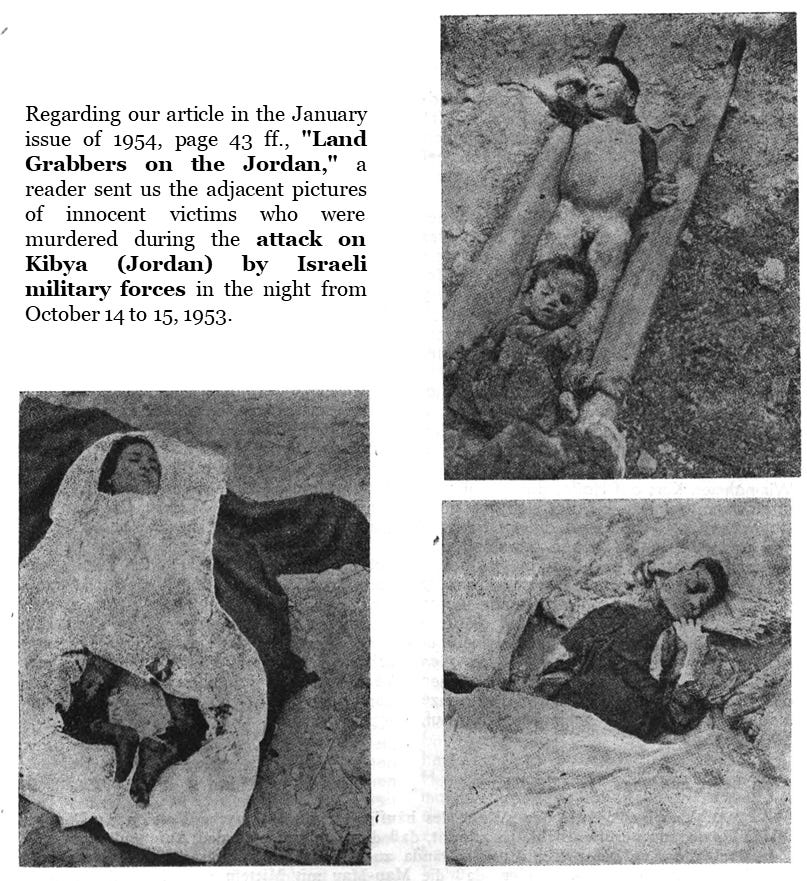
Supplementing our essay “Land Grabbers on the Jordan” (Landräuber am Jordan) (issue 1, pp. 43 ff.) a German doctor from Syria writes to us about similar Jewish atrocities during the expulsion of the Arabs from Palestine in 1948:
“I was at the beginning of this horrible slaughter on board the Italian steamer Grimani, which was on the way to Beyrouth and stopped at noon in Tel Aviv. To our astonishment, following the English port authorities, armed civilians inspiring little confidence boarded, who in an arrogant manner wanted to give orders to the ship’s commander. This energetic captain, however, refused to accept them. When they did not want to leave the ship and wanted to prevent the steamer from sailing, he simply put them ashore and weighed anchor. We set course to Haifa, which we reached in the evening. What a picture offered itself to us there! The sea was covered with all kinds of vessels and rafts on which, screaming and weeping, the people begged with wringing hands to be taken aboard. From the shore incessant shooting sounded, and fires were visible. The Jews massacred the Arab population, which had to endure everything unarmed and fled in all directions, many with vessels onto the sea. We worked the whole night and took aboard the poor people—women, children and old people. Always new ones came; the whole ship resembled a camp. Almost all had saved only their bare lives. Many were wounded because the Jews had shot after them. Some boats had capsized due to overcrowding, and the people held on with their last strength to the vessels until weakness overcame them and they sank. Toward morning the ship was overcrowded; one could hardly move forward anymore. With a heavy heart the captain had to give the order to stop taking aboard the unfortunates and to depart. I will not forget the scenes that followed as long as I live. Countless boats had newly arrived. The people lifted the children up and begged to take at least the children along. It was a screaming that tore one’s heart apart. For what the Jews carried out with their defenseless victims deserves to be preserved for the world. I can cite eyewitnesses who saw the horrible mistreatments and killings, witnesses who are above all doubt. The slitting open of pregnant women’s bellies, the violation and killing of women before the eyes of fathers and husbands, who were afterwards likewise mutilated and murdered in horrible fashion, burning alive, etc., let all of Palestine cry out in agony.”
A reader from Egypt writes to us:
Cairo, Feb. 1, 1954.
“. . . Incidentally, Der Weg had published the Malayan version of the Mau-Mau movement more frequently. It is correct that the communists are fomenting the uprising since the English want to make Kenya and Uganda their main military base. It is equally correct that the Mau-Mau proceed with means that are rejected in the civilized world but under certain circumstances are the only ones available to defend oneself against the foreign oppressors in a land like East Africa. It is, however, furthermore a fact that Egypt and the Arab world, but especially Egypt, do not stand unsympathetically toward the Mau-Mau movement, for, for Egypt, it is a question of national security whether the English continue to sit at one source of the Nile or not. It is of great significance for the Egyptians to know that there are no English troops in Kenya that, in case of an Egyptian action against Israel, could march into the Sudan or Egypt from the south. Egypt must necessarily see this from the African standpoint. Moreover, one of the main reasons for the Mau-Mau uprising was silenced by most newspapers including Der Weg: Thousands of Kenyan Negroes were forcibly recruited by the English and shipped to Malaya to be deployed there in the jungle war against the communists. Many did not return, whereupon the English constantly made new levies. Since the Kenyan Negroes are not in the least interested in losing their lives in Malaya for English interests and finally refused to enter the English army, they were transported away like criminals and pressed into the army. The natives defended themselves against this modern slavery, and thus the Mau-Mau movement came about . . .”
A.S.